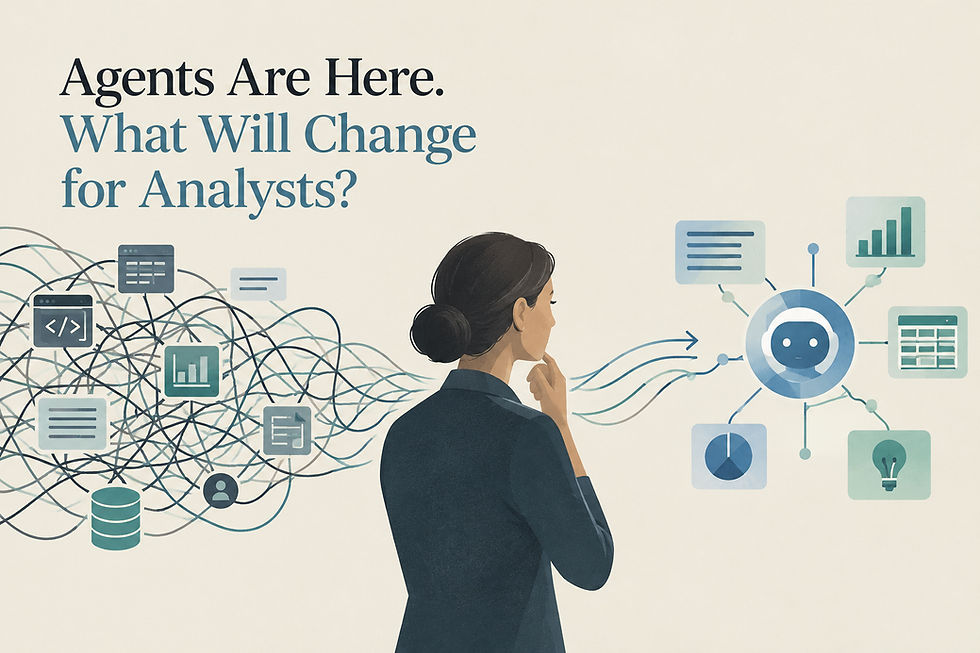
Agents Are here. What will change for the Analyst?

For years, we’ve talked about how AI might change the role of the analyst.
Will AI replace analysts?
Will analysts still need to know SQL?
Will dashboards become obsolete?
I think we’re asking the wrong questions.
Agents are already beco
ming part of the way we work with data. So instead of asking whether analysts will disappear, I think we should ask a more practical question:
If agents can increasingly do the analysis, what will analysts actually do?
I’m currently working as part of a team building a data application that uses agents, data, semantic models, and a knowledge base to help management get accurate and reliable answers from our data.
It is not a small effort.
Data engineers need to create trustworthy data sources. Analysts need to make sure the right business context is represented. Governance teams need to make sure the data is properly governed.
There is a lot of work happening behind the scenes to make an agent capable of answering a seemingly simple business question.
And working on this has made me think differently about the future role of the analyst.
I don’t think the analyst disappears.
I think the job starts moving beyond the traditional role of simply answering questions.
One of the first changes is creating the semantics that agents need.
In the real world, documentation is almost always outdated.
Business rules that should probably be documented somewhere are often embedded in SQL queries, notebooks, Power BI models, or simply stored in someone’s experience.
Humans are surprisingly good at dealing with this.
An experienced analyst can look at a metric and know, “That’s not quite how the business uses this number.”
They know the exception.
They know which definition is actually used.
They know why one report doesn’t match another.
An agent doesn’t automatically have that knowledge.
Agents need context.
This creates an interesting opportunity for analysts.
Analysts are often in the perfect position between the business and the data. We understand what the business means by a metric, but we also understand how that meaning is represented in the data.
That puts us in a unique position to turn undocumented business knowledge into semantics that agents can use.
The analyst’s job starts moving from simply using the data to helping define what the data means.
And that is a very different kind of value.
The second change I see is validating the agent’s output.
An agent giving an answer doesn’t automatically make that answer trustworthy.
The analyst will increasingly need to ask:
Did the agent use the right metric?
Did it understand the business context?
Did it apply the correct business rule?
Did it interpret the question correctly?
Is the answer reasonable?
And perhaps most importantly, can we explain why the agent reached that conclusion?
This doesn’t mean analysts will manually check every answer an agent produces. That wouldn’t scale.
Instead, analysts can help define what a good answer looks like, create representative questions and edge cases, test the agent, identify weaknesses, and improve the underlying semantic and knowledge layers.
The role changes from being the person who produces every answer to being part of the system that makes answers trustworthy.
But there is another side to this transformation that I find particularly interesting.
Management will also need to learn how to ask better questions.
If an agent makes it incredibly easy to ask the data a question, the bottleneck may no longer be access to information.
It may be knowing what to ask.
“Why are sales down?” is a question.
But it might not be a very useful one.
Which sales?
Compared with what?
For what period?
Which customers or products?
Are we trying to understand the cause, identify an opportunity, or decide what action to take?
The analyst may increasingly help management move from simply asking questions to asking better business questions.
This is where the analyst’s understanding of the business becomes even more important.
An agent can help explore the data, identify patterns, and generate possible explanations.
But someone still needs to understand which questions matter, which assumptions are reasonable, and which findings are relevant to the decision at hand.
So, when I think about the analyst of the near future, I don’t see someone competing with an agent to produce a report faster.
I see someone creating the context that allows the agent to produce a better answer.
Someone defining the semantics.
Someone testing and validating the output.
Someone helping management ask better questions.
Someone connecting the analysis back to the decisions the business needs to make.
The interesting part is that none of these responsibilities removes the need to understand the business.
It makes that understanding even more valuable.
Maybe the future analyst won’t be the person who answers every question.
Maybe they will be the person who makes sure the organization—and the agents working for it—are asking and answering the right questions.
And that, to me, sounds less like the end of the analyst role and more like its next evolution.
Start with Data, End with Value.


Comments